

 Facebook
 X
X
 Pinterest
 Copy Link
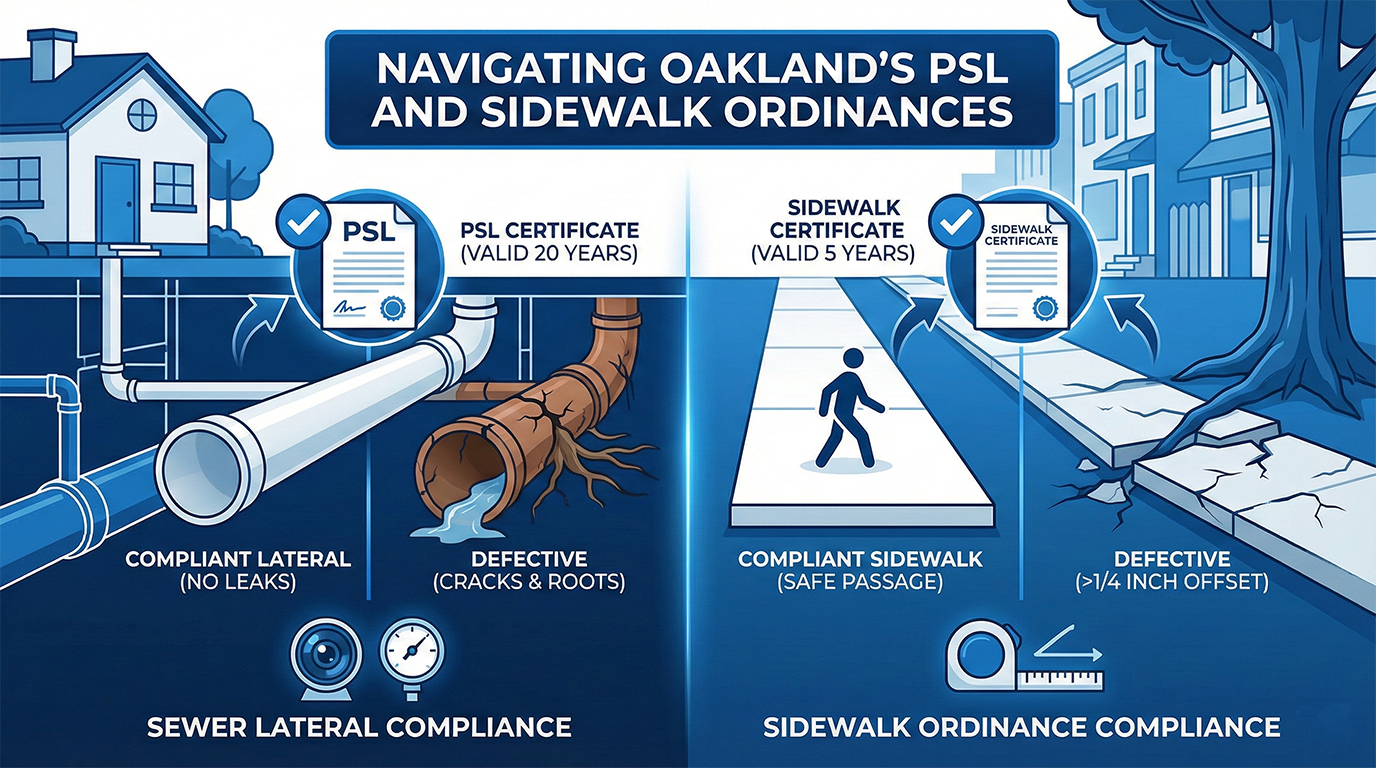
If you’re buying or selling residential property in Oakland, California, understanding two critical compliance requirements can save you time, money, and stress during your transaction. The Regional Private Sewer Lateral (PSL) Ordinance and Oakland’s Sidewalk Compliance Ordinance both mandate specific inspections and certifications before a title transfer can be completed. As your real estate professional, I want to ensure you’re fully prepared for these obligations.
Understanding the Regional Private Sewer Lateral (PSL) Ordinance
The Purpose Behind the Program
Managed by the East Bay Municipal Utility District (EBMUD), the Regional PSL Ordinance addresses a significant environmental challenge facing the Bay Area. Many East Bay homes were built before 1950 with clay sewer pipes that have deteriorated over decades. When these aging laterals develop cracks or become displaced, rainwater and groundwater can infiltrate the sanitary sewer system during storms. This excess water can overwhelm wastewater treatment facilities, potentially causing sewage overflows into San Francisco Bay. By requiring property owners to verify that their sewer laterals are leak-free, the program protects our waterways while preventing costly backups and infrastructure failures.
What Triggers PSL Compliance?
The ordinance applies to properties in Oakland, Piedmont, Emeryville, El Cerrito, Kensington, and the Richmond Annex. Three specific events trigger the compliance requirement:
- Title Transfer – Any sale or transfer of real property containing a structure with a building sewer
- Substantial Renovation – Permit applications for renovations exceeding $100,000
- Water Meter Changes – Applications to increase or decrease the size of your water meter
It’s important to note that certain transfers are exempt from immediate compliance, including transfers between spouses or domestic partners, transfers into or out of revocable living trusts, transfers through inheritance or probate, and transfers between co-owners. However, these exemptions don’t eliminate the requirement—they merely postpone it. The compliance obligation remains dormant until the next non-exempt sale or major renovation triggers it again.
The Compliance Process
Property owners are responsible for the entire sewer lateral from their home to the public sewer main in the street. The process typically unfolds as follows:
- Assessment – Hire a licensed plumbing contractor to perform a video inspection (CCTV) of your sewer lateral to identify any cracks, leaks, root intrusion, or other defects
- Permits – Obtain required permits from the City of Oakland before beginning any repair or replacement work
- Repairs – If defects are found, complete necessary repairs or full replacement according to the Regional PSL Ordinance and municipal requirements
- Verification Test – Schedule an EBMUD inspector to witness a pressure test (either low-pressure air test or hydrostatic water test) conducted by your contractor
- Certificate – Upon passing the test, EBMUD issues a Compliance Certificate that you can download from their online portal
Certificate Validity Periods
The duration of your Compliance Certificate depends on the scope of work performed:
- Complete replacement: Valid for 20 years
- Repairs or passing “as-is” test: Valid for 7 years
The Time Extension Certificate (TEC) Option
Real estate transactions don’t always allow sufficient time to complete sewer lateral work before closing. Fortunately, EBMUD offers a Time Extension Certificate (TEC) that provides a 180-day window after the close of escrow to complete the necessary work. To obtain a TEC, the responsible party must deposit $4,500 with EBMUD before closing. This deposit is fully refundable once compliance is achieved within the 180-day period. However, failure to complete the work within this timeframe results in forfeiture of the deposit and potential penalties up to $500 per day for non-compliance.
The TEC can be a valuable tool when inspections reveal unexpected issues or contractor scheduling delays threaten your closing timeline. However, it should be viewed as a contingency option, not a primary strategy—completing the work before closing whenever possible provides the cleanest transaction for all parties.
Oakland’s Sidewalk Compliance Ordinance
The 2019 Ordinance and Its Intent
Effective July 9, 2019, Oakland Municipal Code Chapter 12 Section 12.04.380 shifted both the maintenance responsibility and liability for sidewalk-related injuries to property owners. This point-of-sale ordinance ensures that Oakland’s pedestrian infrastructure remains safe and accessible while addressing the city’s significant backlog of sidewalk repairs.
When Compliance Is Required
Similar to the PSL ordinance, sidewalk certification is triggered by:
- Title transfer (sale of the property)
- Renovations exceeding $100,000
The Standard: What Constitutes a Defect?
The ordinance adopts the Americans with Disabilities Act (ADA) standard for sidewalk safety. Any vertical offset, crack, or depression exceeding ¼ inch (approximately the width of a standard No. 2 pencil) constitutes a defect requiring repair. This relatively stringent standard means that many Oakland sidewalks—particularly in older neighborhoods with mature street trees—will require some level of remediation.
Common defects include:
- Trip hazards from tree root uplift
- Cracks from soil settlement or seismic movement
- Spalling or surface deterioration from freeze-thaw cycles
- Cross-slope issues affecting drainage and accessibility
The Certification Process
Oakland’s ordinance includes a streamlined “self-certification” process designed to reduce delays, though this has been a source of controversy in the real estate community:
- Inspection – If your sidewalk is defect-free, hire a licensed contractor (or professional engineer or licensed architect) to inspect and verify compliance
- Repairs (if needed) – If defects exist, hire an Oakland-based licensed contractor holding a valid “A,” “B,” or “C-8” license (or “C-42” or “C-57” if concurrent permitted work is occurring) to complete the repairs
- Self-Certification – The contractor who performed the work or inspection completes a Sidewalk Certificate of Compliance and submits it to the OakDOT Permit Counter at 250 Frank H. Ogawa Plaza, 4th Floor
- No City Inspection Required – Unlike traditional permit processes, you do not need to wait for a City inspection to receive your Certificate of Compliance (though the City may conduct random spot checks)
Certificate Validity and Extensions
Once issued, a Sidewalk Certificate of Compliance remains valid for 5 years from the date of issuance. If you’re selling a property with a valid, unexpired certificate, you can simply provide a copy to your buyer—no new certification is required.
If repairs cannot be completed before closing, Oakland now offers a Provisional Sidewalk Compliance Certificate that provides a 90-day extension from the issue date to complete the work. This is considerably shorter than the PSL’s 180-day extension, so planning ahead is even more critical for sidewalk issues.
Special Considerations for HOAs and Condominiums
For properties in homeowner associations or community associations, the HOA typically obtains a blanket Compliance Certificate covering all units. As an individual seller, you should contact your HOA to request a copy of this certificate for your title transfer. If your HOA has not yet obtained certification, you can secure a no-fee individual Compliance Certificate from the OakDOT Permit Counter, though the City may subsequently inspect and issue Notices to Repair to the HOA.
Practical Challenges and Industry Concerns
Both ordinances have generated significant concerns within Oakland’s real estate community:
- Contractor Availability: Limited numbers of qualified contractors have created scheduling bottlenecks, particularly during busy real estate seasons
- Cost Variability: Repair estimates can vary dramatically between contractors, with some property owners reporting estimates thousands of dollars apart for identical work
- Transaction Delays: Even with extension certificates, compliance requirements can extend closing timelines or create last-minute complications
- Scope Uncertainty: Initial inspections sometimes reveal more extensive issues than anticipated, particularly with aging sewer laterals
Negotiating Compliance Costs: Critical Contract Language
While California law requires compliance with both ordinances before title transfer, the financial responsibility for achieving compliance is negotiable between buyer and seller. This is where precise contract language becomes absolutely critical.
The standard California Residential Purchase Agreement (RPA) includes provisions for addressing these requirements, but how they’re completed can dramatically affect your financial obligations:
Key Negotiation Points:
- Who pays for inspections?
- Who pays for repairs if defects are discovered?
- Who pays extension certificate deposits?
- What happens if repair costs exceed expectations?
- Who bears the risk if work cannot be completed within extension periods?
Common Negotiation Strategies:
For Sellers: In competitive markets, some sellers choose to obtain compliance certificates proactively before listing. This demonstrates transparency, eliminates uncertainty for buyers, and can justify asking price. The cost becomes a known marketing expense rather than a negotiation variable.
For Buyers: In buyer-favorable markets, purchasers may negotiate for sellers to handle all compliance costs and provide completed certificates at closing. Alternatively, buyers might accept responsibility in exchange for price concessions that exceed anticipated repair costs.
Split Responsibility: Many transactions allocate inspection costs to sellers and repair costs to buyers with price adjustments, or establish cost caps beyond which the other party contributes.
The Danger of Ambiguous Language
Vague contract provisions like “Seller to obtain PSL certificate” without specifying who pays for repairs or deposits can lead to disputes when unexpected costs arise. Similarly, shifting the $4,500 EBMUD deposit or complex sidewalk repair responsibility requires explicit contract language identifying:
- Who deposits funds
- Who manages contractor relationships
- Who receives refunds upon completion
- What recourse exists if deadlines are missed
Timeline Recommendations
Based on current contractor availability and processing times, I recommend the following planning timeline for Oakland transactions:
- For Sellers: Begin compliance process 60-90 days before anticipated listing date if possible
- For Active Listings: Order inspections immediately upon accepting an offer; don’t wait for contingency periods to expire
- For Buyers: Include compliance contingencies in your offer with realistic timeframes (minimum 30 days for straightforward repairs, 45-60 days for extensive work)
Final Thoughts: Compliance as Investment
While these ordinances represent additional transactional costs and complexity, they serve important public purposes—protecting our waterways, preventing infrastructure failures, and ensuring safe pedestrian access throughout Oakland. Property owners who view compliance as an investment in Oakland’s environmental health and urban infrastructure, rather than merely a regulatory burden, often find the process less frustrating.
Moreover, proactive compliance can enhance property value. A home with current, transferable PSL and sidewalk certificates offers buyers peace of mind and demonstrates responsible ownership—qualities that can justify premium pricing in competitive markets.
Are you planning to buy or sell a home in Oakland this year? Let’s connect to discuss how these ordinances will affect your specific transaction and develop a strategy that protects your interests while ensuring smooth compliance. Early planning makes all the difference.
Contact Gregory Brock | 510-693-8104 | Greg.Brock@cbRealty.com
This article provides general information about Oakland’s compliance requirements as of February 2026. Specific circumstances may vary, and ordinance provisions are subject to change. Always consult with qualified professionals—including your real estate agent, licensed contractors, and legal counsel—for guidance on your particular situation.
